The AI Candidate Edge: Using AI to improve your CV
In the first of his new series on AI in recruitment, Leighton Thomas shares practical advice on using AI to improve your CV, highlight your achievements and stand out from the crowd, while keeping your personality.
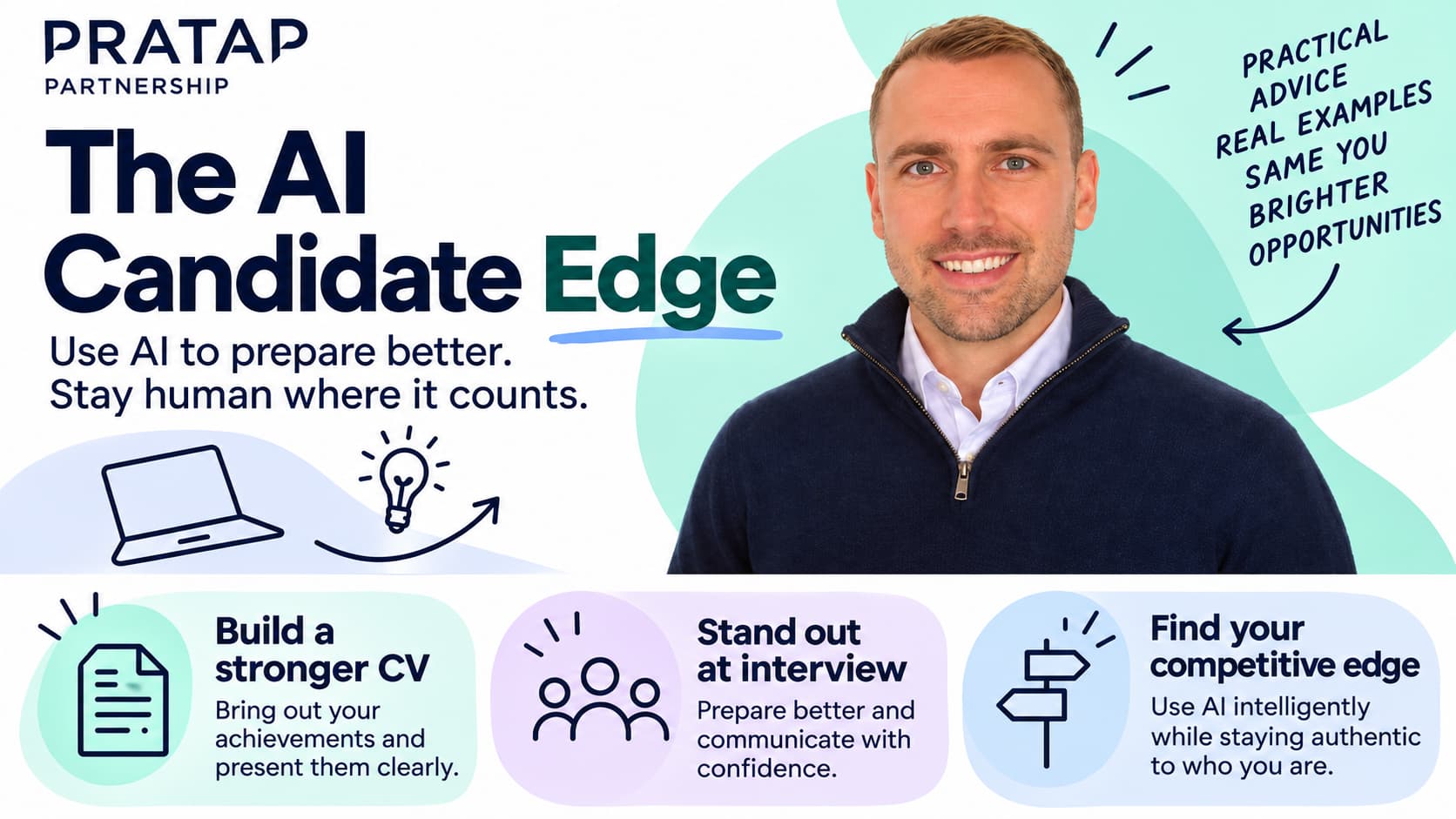
The AI Candidate Edge: Using AI to improve your CV
In the first of his new series on AI in recruitment, Leighton Thomas shares practical advice on using AI to improve your CV, highlight your achievements and stand out from the crowd, while keeping your personality.
Using AI to Make Your CV Stand Out, Not Blend In
I am seeing more and more CVs that read almost exactly the same. The same phrases, the same structure and very little sense of the person behind them.
Often, they look like they have come straight out of ChatGPT without much thought afterwards. When you are reviewing CVs every day, that becomes familiar very quickly and it makes it harder for someone to stand out.
AI can be a really useful tool for writing your CV. But my advice would be to start with your own experience and let AI help you improve how you explain it.
How can you use AI to improve your CV?
Start with an easy win: tidy up your writing
You do not need to rewrite everything. Sometimes, your CV just needs clearer wording, less repetition and a spelling and grammar check.
Try a prompt like:
“Can you tidy up the wording, remove repetition and make my CV easier to read? Keep my tone and do not change the meaning or add any information.”
The aim is to explain what you have done more clearly.
Put some meat on the bones
A phrase I sometimes use with candidates is that their CV “needs more meat on the bones”.
You might have some great experience, but if your CV only lists basic responsibilities, the reader will not see the full picture.
Jot down what you have worked on, what you changed and what the outcome was. AI can help turn those rough notes into clearer examples and achievements. You can also ask it to question you about your experience to help draw out the detail.
Have you improved a month-end process? Helped introduce a new system? Reduced overdue debt? Those are the things worth exploring.
Tailor your CV to the role
Once you have given AI a good understanding of your experience and achievements, you can share a job description and ask which points deserve more attention.
This can make tailoring your CV much quicker. Just make sure you are highlighting relevant experience you actually have. If there is a gap, changing the wording will not fill it.
You don’t have to use the same CV for every application. For example, if you are applying for a commercially focused finance role, you could give more space to your business partnering, analysis and experience supporting operational decisions. For a financial accounting role, you might put more emphasis on reporting, controls and technical accounting.
You can attach the job description alongside your CV and ask AI which parts of your experience you should highlight. With a clear starting point, you could have a tailored version ready to review in five minutes.
Another option is a short key skills section, set out across three columns so it is easy to scan. Ask AI to suggest which of your skills are most relevant to the role, using language from the job description where it accurately reflects your experience.
The aim is to make the connection between your experience and the role easy to see. Keep it natural, avoid repeating keywords for the sake of it, and make sure you can back up everything you include.
A few tips I would keep in mind
Talk it through
If you are like me, getting your thoughts down in writing is not always easy. Sometimes, it is much easier to explain something out loud.
Something I have started to use more is the voice tools on your AI app to talk through your experience instead of typing it all out. You can also use a dictation tool to turn what you say into written notes (apps such as Wispr Flow). Do not worry about getting every sentence right, the idea is to get your thoughts down first.
For example, you might say:
“When I joined, month-end was taking too long. I looked at how we were doing the reconciliations, changed the process and helped the team get the reporting out earlier.”
You can then ask AI to help turn that into a clear CV point. Or your AI can ask you questions to draw out more detail.
That is where it becomes useful. You do not have to sit staring at a blank page trying to write the perfect bullet point. You can talk through what happened and build from there.
I would keep a dedicated space in your AI tool for these examples. Whenever you remember a project, an achievement or a difficult situation you handled well, talk it through and save the notes. Over time, you will build a bank of examples for your CV and interviews.
Here is an example of how you can structure your conversation:
Set out the Context
“I want to produce a CV that is entirely authentic but brings out the best version of me”
Give your AI a role to play
“I want you to be the Finance Director of an SME in Leeds. I want you to look at me through their eyes and guide me on how to present myself”
Interview me
“Ask me questions to help us both understand who I am, what my proudest achievements are and to make me self-aware - of my past and my future ambitions”
Build the CV
“I will upload my current CV - please evolve it from our conversation above and prepare me a first draft to review”
Check what AI is putting in
It is easy to accept what AI gives you because it sounds polished. This is where you need to stay involved.
Read every line and make sure it accurately reflects your experience. Can you explain the achievement? Did you lead that project or support it? Are those figures correct?
Otherwise, you could find yourself being asked some awkward interview questions about something you have not actually done.
Keep your personality
This is the most important point for me: use AI to help you, but do not let it strip away your personality.
Your CV should still feel like yours. Keep the language natural and, if you include hobbies and interests, make them specific to you.
It is already difficult to summarise who you are on a couple of pages. Do not let AI make that even harder by making you sound like everyone else.
Keep the format simple
Different sectors have different expectations, but finance is the area I know. In my experience, the strongest CVs are usually clear, well structured and easy to read.
I would not overcomplicate things with fancy graphics, pictures or unusual layouts. Think about the FD or CFO reading it: make it easy for them to find your experience, qualifications and achievements.
You have one the work and built the experience. Use AI to help you explain it and make sure the finished CV still sounds like you.